

 Tim Zyla
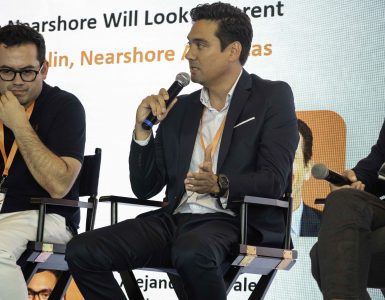
Sofka Technologies’ Tech Day, held last week in Medellin, brought together IT leaders from across the Americas for an annual forum that served as an update on the tech services’ industry and a look toward the future. And the speakers couldn’t stop talking about artificial intelligence.
Based on a wide-ranging set of panels and conversations, one clear takeaway emerged: AI is the future, but we don’t know exactly what that’s going to look like.
Hosted in a country where more than 20% of the population does not have access to the internet, the forum also spotlighted the need for AI platforms that fit culturally with Latin America. As one speaker noted, asking ChatGPT to speak Spanish like a Colombian will result in Mexican Spanish being spoken.
The forum also served as a platform for leaders to talk about the importance of trust in the AI adoption process. Executives spoke about the need for companies, clients and employees to improve trust in AI despite negatives like hallucinations, which continues to decrease as models are updated.

Sofka Technologies CEO and Co-Founder Esteban Alonso summed up his opening speech by talking about the importance of sustainable AI adoption.
“We cannot afford to look away,” Alonso said. “We need to be leaders of correct adoption.”
Here are the five biggest takeaways from the day’s presentations:
Ethics and Transparency Are the Pillars of Trust
When Fran Gómez, of The Open Group, shared an anecdote about a Mexican client using AI to “sense lies” during business interactions, the room paused. His point was sharp — it’s not enough to unleash AI into sensitive contexts, organizations must take responsibility for how it is designed, deployed and explained.
“We cannot pretend AI can learn ethics on the spot,” he said.
Diners Club Chief Technology Officer Eduardo Rodríguez built on that, asking, “Would you want to be evaluated by AI?”
He said probably not, unless the system was completely transparent in how it judged performance. Transparency, he argued, is the difference between trust and distrust in the digital economy.
InterBank Transformation Manager Alfred Kobayashi echoed this, insisting that for services like lending or hiring, companies must be “the most transparent as possible” in order to protect customers.
The urgency isn’t just philosophical. A recent McKinsey survey found that fewer than 20% of companies track clear KPIs for generative AI, and less than one-third have embedded AI into core business processes. Without that transparency, organizations risk both reputational blowback and regulatory scrutiny.
Without an ethical and transparent foundation, AI adoption risks collapsing under its own weight.
Agility Must Be Anchored by Regulation
Agility — the ability to adapt quickly — was another buzzword at the conference. Several panelists cautioned that agility without regulation is dangerous.
Rodríguez said trying to implement AI without regulatory “wheels” is like riding a bicycle with one wheel missing.
This tension is already visible in financial services. Gómez, who recalled witnessing JPMorgan test an “autonomous bank” model that, within 72 hours, triggered regulatory alarms.
“It was capable of breaking open the financial system,” he said, urging caution about code that regulators cannot keep pace with.
McKinsey estimates that for every $1 companies spend on generative AI tools, they may spend up to $3 on change management — training staff, redesigning processes, and building governance frameworks. And according to the Financial Times, only 6% of retail banks are ready to scale AI at all, citing concerns about job losses, compliance hurdles, and institutional inertia.
Protección COO and CIO Mauricio Ferrer stressed that agility must also be tied to value creation: “Does this add revenue? We need to provide value to whoever is investing.” For businesses, agility isn’t just moving fast — it’s moving responsibly.
Latin America Needs Its Own AI Lens
Several speakers pushed back against what they called “international recipes” being imposed on Latin America.
“ChatGPT does not think like a Latino person,” said LatAm AI Hub President Diego San Esteban.
From dialect to cultural nuance, imported AI often struggles to resonate with local users.
This cultural mismatch has tangible consequences. According to Brazilian industry data, only 38% of large firms use AI, with high costs, talent shortages and infrastructure gaps acting as barriers. Meanwhile, a recent academic paper identified Argentina, Colombia, Uruguay, Costa Rica and Ecuador as rising AI hubs, thanks to stronger education pipelines and financing.
The panelists agreed. Adoption in Latin America cannot simply mean importing tools built in Silicon Valley or Shenzhen. Deuna Chief Product and Technology Officer Felipe Duclos emphasized that “pilot projects must begin inside companies, behind the scenes, where risks can be managed.”
It was also suggested that open-source training models, adapted locally, may be the only way to ensure cultural and linguistic fit.
At stake is more than convenience — it’s about trust. If AI tools fail to speak to Latin Americans in their own terms, adoption will remain shallow.
AI Won’t Replace Us, But It Will Redefine Work
Another recurring theme was the future of work. Contrary to the popular narrative of mass job losses, panelists argued that AI will reshape roles rather than eliminate them outright.
“Humans must always remain the supervisors,” Duclos said. “AI can do something autonomously, but people must give it purpose.”
Sofka described its own shift to an “AI-first” training program: all 2,000 new hires now go through AI education modules, not to replace their work, but to redefine their roles with more responsibility for oversight, ethics and strategy.
Gartner projects that by 2028, 40% of roles will be redefined by AI, not destroyed. McKinsey, meanwhile, found that 92% of companies plan to increase AI investment in the next three years, but only 1% consider themselves “mature” adopters.
In other words, AI is less about replacement and more about reshaping how people work — and whether they are equipped to handle those changes.
AI Is a Medium, Not the Destination
Perhaps the most resonant insight came from Alonso, who warned that AI must be seen as a tool, not an end state.
“AI will continue to be the medium — it’s not the end of the process,” he said. “It’s helping us to do things better, at lower cost, with greater efficiency.”
Real-world numbers underscore the opportunity. McKinsey estimates that generative AI could deliver $200 to $340 billion annually to the global banking sector, or about 3 to 5% of total revenues, through efficiency and innovation. Reuters similarly reports that AI could lift banking profits by $170 to $340 billion by 2028, largely through reduced paperwork and more effective customer service.
But Alonso — and many others — stressed that capturing those benefits requires leadership.
Sofka, for example, has made AI adoption part of its corporate university, training both employees and outside engineers to adapt.
The destination, then, is not “AI everywhere” — it’s AI enabling better outcomes in finance, medicine, retail and beyond.
“AI won’t destroy us. But if we don’t lead, it might leave us behind.”





Add comment