
 Narayan Ammachchi
Physical AI is breathing new life into India’s IT and BPO industry at a time when autonomous AI tools such as Anthropic’s Claude are steadily taking over the coding and back-office work that once powered the country’s technology boom.
In Bengaluru, the city often called India’s Silicon Valley, a new kind of worker is quietly emerging. Laborers can now be seen wearing cameras strapped to their heads, recording every movement as they work. These image collectors earn around 300 rupees (US$3) for an hour of video footage. The recordings are later processed and fed into AI systems, teaching robots how to perform the same tasks.
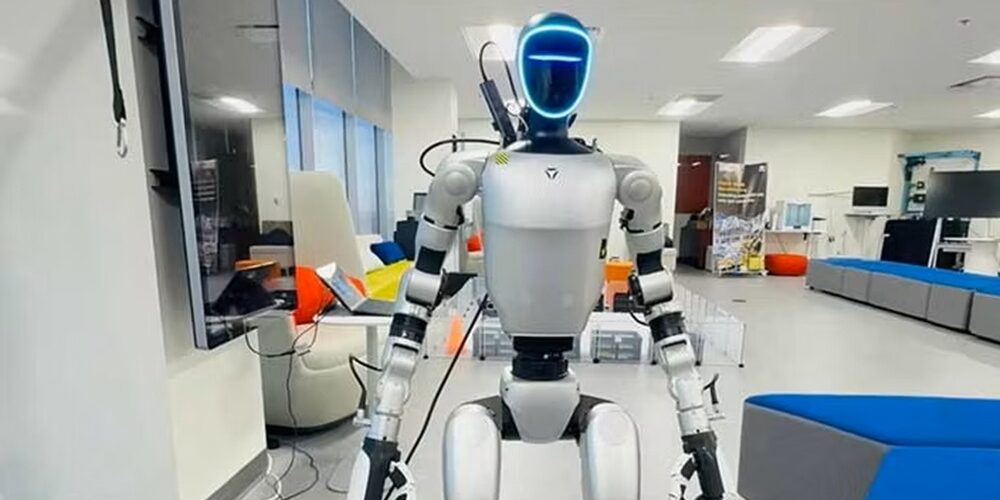
At its core, physical AI is about giving machines the ability to understand and act in the real world. Picture a factory worker picking up a component, inspecting it and placing it on a conveyor belt. Now picture a robot learning to do exactly the same thing after watching thousands of similar examples. That is the essence of physical AI.
Teaching a robot is not very different from training a new employee. Before it can assemble products, move inventory or assist patients, it must first observe how humans perform those jobs.
That learning process requires mountains of data. Cameras capture human movements. Sensors track every action. Machines record how equipment behaves in real-world settings. India’s IT and BPO companies are increasingly being hired to collect, verify and organize this information, transforming everyday human activity into training material for the next generation of intelligent machines.
“We see continued momentum in AI-powered solutions like physical AI, which is robotics, AI factory,” HCL Tech said in its Q3 press conference.
The opportunity is attracting global attention. According to a recent survey by French technology firm Capgemini, 79% of organizations are already engaging with physical AI.
“The opportunity could prove highly lucrative if Indian firms move quickly and secure a position higher up the value chain,” says Nataraj Balasubramanian, CEO of Braiin Limited, a Nasdaq-listed firm that provides AI solutions to the agriculture and real estate sectors.
Traditional BPO services often generate thin margins because vendors compete largely on cost. Physical AI work, by contrast, requires specialized expertise, allowing companies to command higher fees and build deeper, longer-term relationships with clients, he added.
Balasubramanian, whose firm has a significant presence in India, cautions that Indian companies should avoid becoming mere suppliers of low-end data-labeling services.

“The real money is in owning more of the pipeline, from collection to model-ready datasets.”
In other words, the biggest winners will not be the companies simply gathering raw data. They will be the ones helping build the intelligence that allows machines to see, understand and act in the physical world.
Many Indian technology firms appear to have understood that message. Rather than remaining at the bottom of the value chain, they are moving into higher-value services and securing contracts from large industrial conglomerates with deep pockets.
Companies in Physical AI
HCL Tech recently secured a contract with an aviation company to support aircraft cargo operations.
The company has also launched its own AI platform, “TraceX,” for the manufacturing sector. The platform tracks medicine inventories and monitors robotic movements inside warehouses in real time.
Among Indian firms, however, Tata Consultancy Services (TCS) is emerging as one of the most aggressive players in physical AI services.
The Mumbai-based technology giant recently partnered with CEA, a French research institute, to develop physical AI solutions. Earlier in March, it opened an innovation center in the US state of Michigan where clients can explore physical AI technologies tailored to their needs. The facility also allows manufacturers to test AI-powered robots and industrial safety solutions before deploying them on factory floors.
TCS Chairman N. Chandrasekaran has also indicated the scale of the company’s ambitions, recently saying that TCS could eventually have as many AI agents as human employees. The company currently employs more than half a million people.
Earlier this year, Wipro made headlines after landing a deal with Norway’s Kongsberg Digital to develop AI-powered digital twins for energy and utility companies. Digital twins are virtual replicas of physical assets such as factories, power plants and industrial equipment, allowing operators to monitor, simulate and optimize real-world operations.
Specialist vendors such as Tech Mahindra and LTIMindtree are also expanding their capabilities in smart factories, industrial automation, connected devices and engineering services.






Add comment