

 Tim Zyla
Eric Farnsworth, a longtime voice in hemispheric affairs and former White House and State Department official, will kickoff Nexus Miami with a keynote address on the state of U.S.-Latin American relations.
Farnsworth’s speech, on Thursday, Oct. 9, in Miami, could not come at a more relevant time as economic tensions continue to rise amid a U.S. foreign policy shift that has led to global tariff wars and, most recently, a discussion of potential military action against Venezuela.
This week, Secretary of State Marco Rubio is visiting Mexico and Ecuador, his third trip to Latin America this year, in an effort to strengthen cooperation with the U.S.
Farnsworth’s career in international policy began at the close of the Cold War, a period he said shaped his path. He is a Truman Scholar and graduated from Princeton University with an MPA in International Relations.
He joined the U.S. State Department in 1989, initially focusing on Panama following the U.S. invasion to remove Manuel Noriega. That experience, he said, set him on a course through Central America and into the Clinton White House, where he worked from 1995 to 1998.
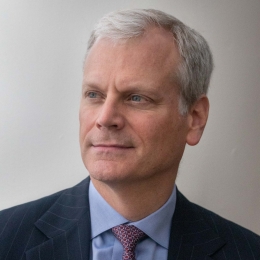
“I had been responsible for shepherding an agreement between the United States and Central America,” Farnsworth said of his early role at the State Department.
During his decade in government, Farnsworth said Western hemispheric relations reached a high point before the turn of the century.
The 1994 Summit of the Americas in Miami, he said, was marked by optimism.
“The Cold War ended, dictatorships in the region were ending, the Central American wars were ending, and there was a real sense of a common agenda coming out of the summit in ’94, a real sense of optimism that dissipated over time. That’s when I got really invested in the region with a sense of possibility,” he said.
After leaving government in 1998, Farnsworth spent five years in consulting before returning to the policy world in 2003 to lead the Washington office of the Council of the Americas. He remained there until earlier this year, when he transitioned to new affiliations, including the Center for Strategic and International Studies.
“After 9/11, the dynamics began to change to the point where in the 10-year time from the 1994 Summit in Miami to the 2005 Summit of the Americas in Mar Del Plata, Argentina, you went from 34 countries in the region signing on to the North American Free Trade Agreement to the entire thing breaking apart.” — Eric Farnsworth
He described his tenure in the White House as a unique period.
“There was no social media. There was internet, but it wasn’t much to speak of,” he said. “So you really did have access to the best information that was out there as much as anybody did. And then when you left, you didn’t have that same access.”
Farnsworth also recalled the prestige of serving in government.
“You get to represent the American people overseas, and you get to be part of something historic and obviously bigger than yourself,” he said.
Reflecting on what changed after the peak of cooperation in the 1990s, Farnsworth pointed to three significant developments: The election of Hugo Chávez in Venezuela in 1998, the Sept. 11 attacks in 2001 and China’s growing presence in the hemisphere.
“After 9/11, the dynamics began to change to the point where in the 10-year time from the 1994 Summit in Miami to the 2005 Summit of the Americas in Mar Del Plata, Argentina, you went from 34 countries in the region signing on to the North American Free Trade Agreement to the entire thing breaking apart,” Farnsworth said.
Today, he sees uncertainty as a central challenge for business and policy in the region.
“It’s not about (American) jobs being taken by Latin Americans. It’s that we don’t know how to plan because we don’t know what the structure is of the markets that we’re going to be trying to operate in,” he said.
On the role of China, Farnsworth urged balance and promoted the need for American competitiveness.
“If you ask the same question to people in Washington, you’re gonna get a hair on fire response, right? The Chinese are taking over,” he said. “But if there’s no alternative, then there’s no alternative. You can’t really complain that someone wants to use Huawei 5G if you don’t have an alternative that can provide the same level of service at a similar cost.”
Farnsworth continues to write and speak on policy issues and said he hopes to see Western hemispheric relations revert back to the sense of harmony that was achieved in the 1990s.
“Once you get invested in the region, you see how vibrant, how interesting, how varied, how diverse, how confusing and how frustrating it can be at times.
“It’s endlessly fascinating,” he said.






Add comment