
 Manoj Sharma
Guatemala’s business process outsourcing (BPO) sector has the workforce that US companies want to run their nearshore operations: young, cost-competitive, geographically close. But it doesn’t have enough people who can speak English, and the education system isn’t required to close that gap in a country that heavily depends on the outsourcing industry.
The Central American country ranks 58th out of 116 countries worldwide, according to the EF English Proficiency Index, placing the country in the moderate-to-low English proficiency range, a clear hurdle for outsourcing companies that require high proficiency to manage international clients. “Of course, English is always the main struggle. English is a problem, but we’re not going to fix it,” Eduardo Arevalo, Vice President of Talent Acquisition at Allied Global and President, BPO & Contact Center Sector Guatemala – AGEXPORT, told Nearshore Americas.
The existing workforce offers neutral, easily understood accents, but the overall pool of English-speaking talent doesn’t match countries like the Philippines.
— Joselynne Méndez Rodríguez, Investment Promotion Advisor, Invest Guatemala

It’s the reason that Guatemala’s BPO and ITO industry is still trying to find its footing despite becoming one of the most valued hubs in Central America. “The existing workforce offers neutral, easily understood accents, but the overall pool of English-speaking talent doesn’t match countries like the Philippines,” says Joselynne Méndez Rodríguez, Investment Promotion Advisor at Invest Guatemala, the agency that works with the public sector to attract investment and expand job opportunities nationwide. “In the Philippines, you’ll find pretty much everyone speaking in English, but in Guatemala it has been a little bit of a challenge,” she tells Nearshore Americas.
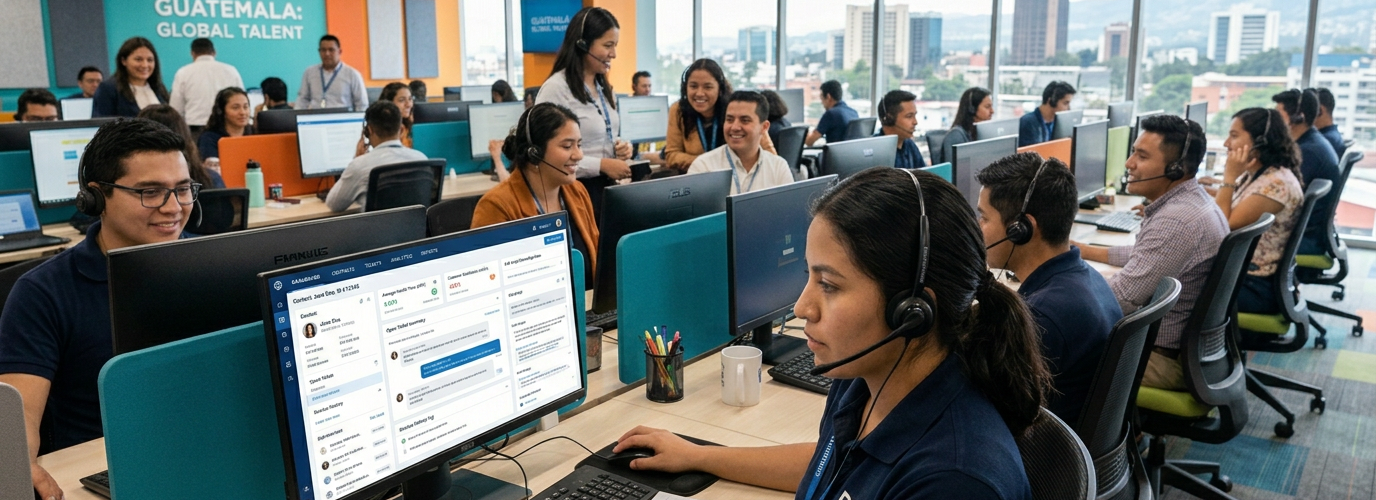
Guatemala is the largest economy in Central America, with a working-age population of 11.8 million. Telecommunications holds the highest share in the BPO services at 35.2%, followed by media and entertainment (13.2%) and manufacturing, retail and e-commerce (10.7%). Some of the biggest US players, including Concentrix, Conduent, Everise and Telus Digital, have their BPO/CX operations in Guatemala.
The Central American country has strong exposure to American culture; people consume American TV and music shows. However, the education system doesn’t seem to be equipped to make them English-ready. “The biggest challenge is that English isn’t taught as part of basic education. Every year 60,000–70,000 students graduate, and most of them — including public-school and even many private-school graduates — aren’t required by law to learn English (roughly 60% of private education is not English-focused either),” Ninoshka Linde, Board Director and Founder, LatamThrives, a C-Level Advisor on GBS, FDI & Global Expansion, told Nearshore Americas.
Shrinking Pipeline Amid Growing Industry
Despite being Central America’s largest economy, Guatemala lacks enough English-speaking high school graduates to support the continued growth of its outsourcing industry, according to industry executives. There are structural issues: universities teach in Spanish, with very few offering English graduation certifications. Both Mendez and Arevalo point to the same set of root problems: a shortage of English-proficient talent, no requirement of English at the graduation level in either public or private institutions, and a heavy concentration of talent and companies in the capital.
It is definitely a big problem. Bonuses are going from $500 up to $2,000 to be hired. So, you see a lot of agents moving away from the BPO they’ve been working for to a new one. They collect a signing bonus and move to another country.
— Eduardo Arevalo, V-P of Talent Acquisition at Allied Global and President, AGEXPORT
 This concentration has saturated Guatemala’s labor market, locking the industry into a costly, ongoing cycle of poaching. “It is definitely a big problem. Bonuses are going from $500 up to $2,000 to be hired. So, you see a lot of agents moving away from the BPO they’ve been working for to a new one. They collect a signing bonus and move to another country,” says Eduardo, adding the country has to expand beyond the primary hubs to allow more secondary markets to grow.
Linde thinks the government’s efforts are not enough as political will is lacking when it comes to making the youth market ready for international companies. “Every 4 years a new government has to be re-educated on why this matters. There’s a narrative resistance: some officials worry teaching English will drive mass migration to the US, so some scholarships have been blocked. In reality, data shows people prefer to stay — a dignified job and income in Guatemala goes further than migrating. People here are family-oriented and want to stay close to home,” she stresses.
She also believes that despite these structural issues, talent quality is high in Guatemala. “Even with a smaller pipeline, Guatemala attracts top-tier call centers because of delivery quality, not volume. About 90-95% of middle management and above in the industry started as frontline agents: proof of the quality of training and career progression.”
The real issue is that the industry is growing faster than the talent pipeline, so when a shortage hits, poaching happens everywhere, she adds. “It’s a global phenomenon, not unique to Guatemala. The framing should be: this isn’t a lack of people, it’s a lack of training.”
How To Fix Guatemala’s Talent Problem
Despite shortcomings, industry believes the government’s intentions are in the right place, and that efforts are being made to make young candidates job-ready. “Guatemala has strong engineers, doctors, and nurses — but many lack English. One bright spot: after 10th grade, students can choose a 3-year technical/vocational track, and there are related initiatives like “Guatemala No Se Detiene” offering scholarships, though progress since 2021 commitments is unclear,” Linde maintains.
Eduardo says AGEXPORT has partnered with the Guatemalan Institute of Technical Education to provide scholarships and training courses. There’s a legislative push— currently in its third reading —to make English mandatory for graduation in public and private schools. The government’s Guatemala Moving Forward is attracting new businesses. Talks are on with the government to increase the tax incentives for BPOs from 10 years to 15 or 20 years.
But how long will it take for Guatemala to fully overcome the talent crunch and language problem? Eduardo acknowledges it’ll take time for the policies to have an impact. “I don’t think it will produce immediate results. But within three to five years, we should begin to see meaningful progress.”
“The government needs structural change, not surface fixes — starting with mandating English education from the root. This isn’t about isolated players acting alone but transforming a generation the way GBS transformation played out in India and the Philippines, and is now happening in Egypt, Ethiopia, and South Africa.”
— Ninoshka Linde, Board Director and Founder, LatamThrives
Call for Structural Changes Amid AI Threat
 Guatemala isn’t just an agricultural exporter of coffee, bananas, and sugar, but its knowledge economy is one of the strongest in Central America, generating $882 million in export revenue, as per the latest sector figure published by AGEXPORT. The sector supports around 170,000 people, making it one of Guatemala’s largest formal service employers.
But beyond the talent shortage, AI has emerged as another challenge for the knowledge economy, and many companies are no longer hiring junior software engineers. The number of graduates hired by US tech firms has also dropped by nearly 50% compared to pre-pandemic levels, according to a study by venture capital firm SignalFire.
Ninoshka believes AI won’t take over everything in markets like Guatemala — it will absorb certain operational parts, but people with different skill sets will still be needed. “The government needs structural change, not surface fixes — starting with mandating English education from the root. This isn’t about isolated players acting alone but transforming a generation the way GBS transformation played out in India and the Philippines, and is now happening in Egypt, Ethiopia, and South Africa.”






Add comment