
 Narayan Ammachchi
Caribbean countries have long stored their data in foreign facilities, but that is beginning to change with the rise of artificial intelligence.
Today, from Curaçao to Puerto Rico, governments are mulling plans to establish data centers of their own.
Oil-rich Guyana set the pace late last year when it signed a memorandum of understanding with Cerebras Systems to develop and operate an artificial intelligence-focused data centre of up to 100MW in Wales, Demerara.
Google has also stepped in. The Silicon Valley giant is reportedly investing in a subsea cable and connectivity project in the Dominican Republic. Such projects typically involve landing stations and may include associated data infrastructure.
A regional push is now underway to provide each country with affordable data space.

“Our aim is to build a cluster of interconnected data centers so each country can get a space to store their data with little expenses,” said Giovanni King, Chairman of the Caribbean Data Center Association.
Speaking from Curaçao, King said the region has no need for electricity-guzzling mega campuses. “There is no point in building data centers for the sake of building,” he told Nearshore Americas.
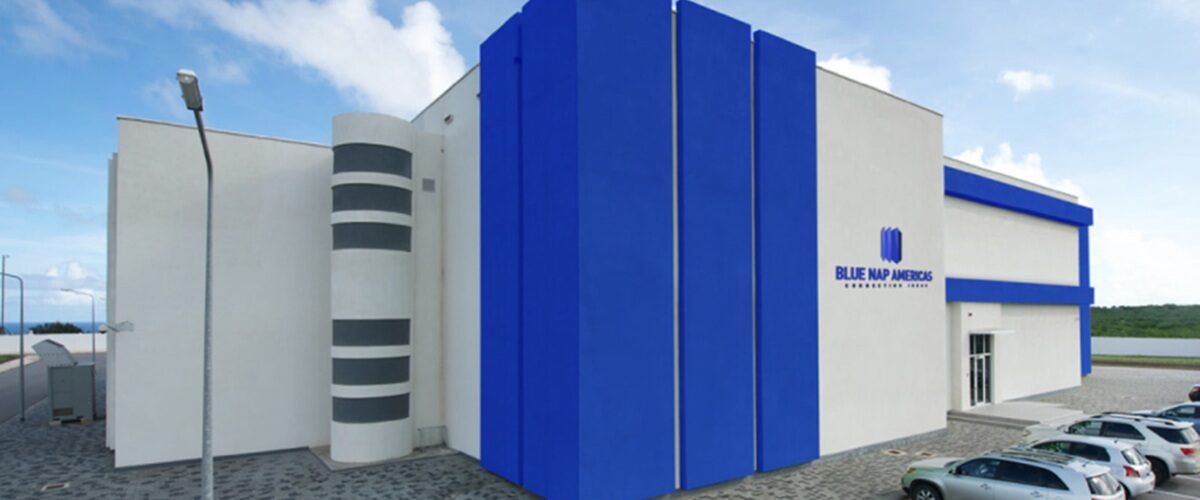
King’s Blue NAP Americas facility in Curaçao remains the only Tier IV data center in the Caribbean. Recently, Blue NAP partnered with Cloud Carib, one of the largest managed and cloud service providers in the region, as part of broader industry collaborations aimed at strengthening regional cloud and data infrastructure.
The distributed model suits the Caribbean’s geography. Many islands sit directly in the hurricane belt. A networked system allows data to shift quickly if disaster strikes. If one site goes down, another can take over.
Policy frameworks such as the Caribbean Community Single Market and Economy and the Single ICT Space also provide a foundation for coordinated development.
“We are currently working on one of the first proof-of-concept projects linking a data center in Curaçao with one or more facilities in Trinidad and Tobago.”
“Curaçao currently has limited data center capacity, but once a new Tier IV facility is completed, both islands — which are outside the main hurricane belt — can offer geographic redundancy. That strengthens resilience,” King added.
The Caribbean comprises around 34 territories and sovereign states. Yet only a few operate domestic data centers, including The Bahamas, the Dominican Republic, Puerto Rico, Curaçao and Trinidad and Tobago, with most others still in the development stage.
ICT and Electricity
On connectivity, the Caribbean holds a strategic edge. The region sits at the crossroads of major subsea fiber routes linking North America, Latin America and Europe. This position gives several islands a latency and redundancy advantage.
Most islands have at least one subsea cable connection. While some older systems are nearing end-of-life, new projects are in the pipeline. Satellite connectivity is also advancing, with Low Earth Orbit networks emerging as another option.
Energy, however, remains the core constraint.
Even smaller facilities come with high operating costs, said Arif Gasilov, Partner, Sustainability & ESG Strategy at Gasilov Group.
“Caribbean electricity prices average around $0.25 per kWh, more than double the US average, and in some island nations they exceed $0.40 per kWh,” Gasilov added.
“Over 90% of power generation in the Eastern Caribbean still comes from imported fossil fuels. The World Bank approved a $110 million Caribbean Resilient Renewable Energy Infrastructure Investment Facility in April 2025 for Grenada, Saint Lucia, and Saint Vincent and the Grenadines, and is investing nearly $500 million in Caribbean renewable energy projects more broadly, but progress is slow.”
As of 2022, only about 12% of the region’s electricity came from renewables. The gap between current grid capacity and the level required to reliably power data centers remains wide, Gasilov said.
King challenges the perception that costs are prohibitive. “It is not necessarily as costly as people assume. It depends on traffic volume and infrastructure already in place.”
He argues that full data localization is not essential. Governments can classify information based on sensitivity. Critical data can remain within national borders, while less sensitive workloads can be hosted through bilateral arrangements with trusted neighbors.
Energy prospects are also evolving. Guyana, Trinidad and Tobago, and Suriname possess strong energy resources. Dominica is preparing to scale up geothermal power production and plans to lay cables beyond its shores to export electricity.
“Importantly, we do not need to build hyperscale, gigawatt-level facilities on every island. That is not our requirement. We build for purpose,” King said.
“Nor do we need GPU-heavy AI training infrastructure like you might find in Brazil. The Caribbean strategy is about smart utilization of existing resources. Build what you need. Do not build for the sake of scale alone.”







Add comment